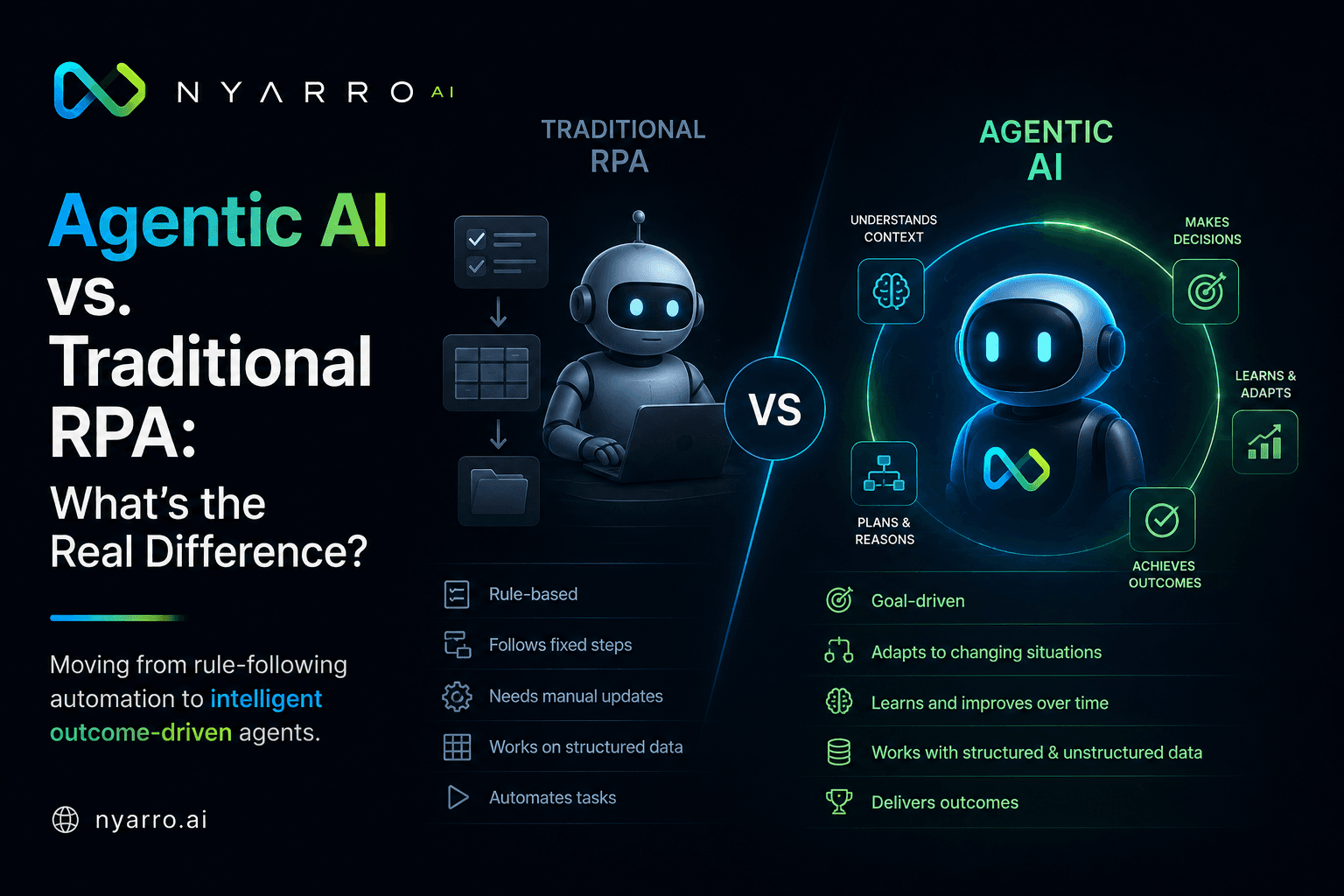
Both automate business processes. Both promise to reduce manual work and improve efficiency. Yet agentic AI and traditional RPA are fundamentally different technologies with distinct strengths and limitations. Understanding the differences—and knowing when to use each—is critical for building the right automation strategy.
Traditional RPA: The Rule-Following Robot
Robotic Process Automation (RPA) automates tasks by recording and playback. You teach the RPA bot the steps: "Click button A, fill in field B, submit form C." The bot executes these steps exactly, consistently, and tirelessly.
RPA excels at:
RPA struggles with:
Agentic AI: The Thinking Robot
Agentic AI systems combine reasoning, planning, and action. Unlike RPA, agents understand context, interpret ambiguity, and make decisions. They can handle unstructured data, navigate exceptions, and adapt to new situations without explicit reprogramming.
Agentic AI excels at:
Agentic AI challenges:
A Practical Comparison
Let's say you need to automate invoice processing:
Traditional RPA Approach
- • Extract structured fields (invoice number, amount, date)
- • Validate fields against known ranges and formats
- • Follow pre-defined routing logic
- • Flag exceptions for human review
Works great for consistent, well-formatted invoices. Breaks down when invoices have unusual formatting, missing fields, or edge cases.
Agentic AI Approach
- • Interpret invoice content regardless of format
- • Extract fields even when they're positioned unexpectedly
- • Handle missing information intelligently
- • Route based on semantic understanding of invoice type and content
- • Adapt routing rules based on business context
Handles messy, varied invoices gracefully. Understands intent and context, not just format.
The Real Answer: Use Both
The most powerful automation strategies combine RPA and agentic AI at their sweet spots:
The Hybrid Model
Use RPA for the high-volume happy path: document receipt, basic extraction, database updates. Use agentic AI at decision points and exception handling: interpreting ambiguous data, making judgement calls, adapting to new scenarios.
This approach gets you the best of both worlds: RPA's reliability and predictability for routine operations, plus AI's flexibility and intelligence for complexity. Your system handles the happy path with RPA efficiency while delegating judgement calls to AI.
The Future: Intelligent Automation
Organisations that win in automation aren't choosing between RPA and AI. They're building integrated systems where intelligent agents orchestrate robotic automation, handling both the routine and the exceptional.
The question isn't "RPA or AI?" It's "How do we combine them to build automation that's both reliable and adaptable?"
Connect With Us
Let's Build Something Remarkable
Whether you have a specific project in mind or want to explore possibilities, reach out — you will hear back from a senior engineer, not a sales team.